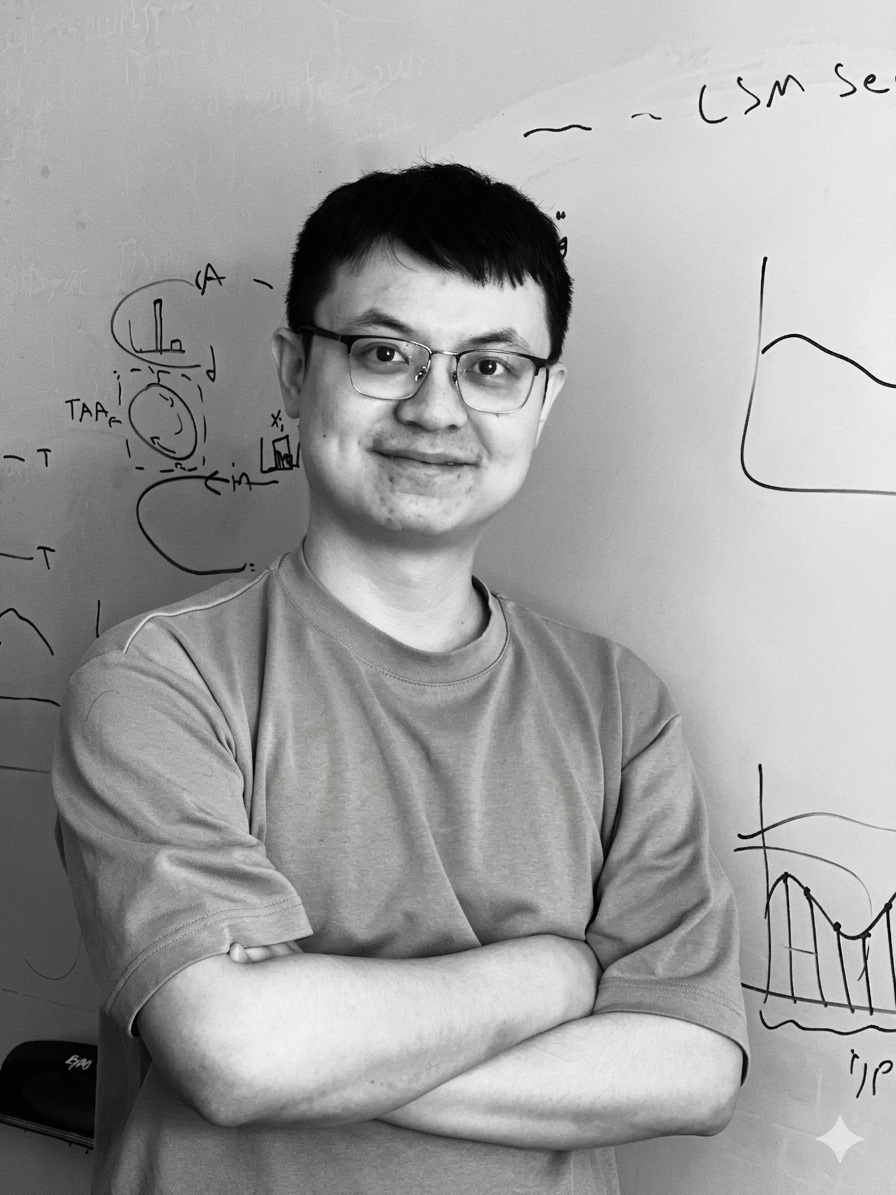
A physics PhD candidate at the Joint Quantum Institute, UMD. I build photonic chips that bend light in unusual ways — and try to make those tricks robust enough to be actually useful.
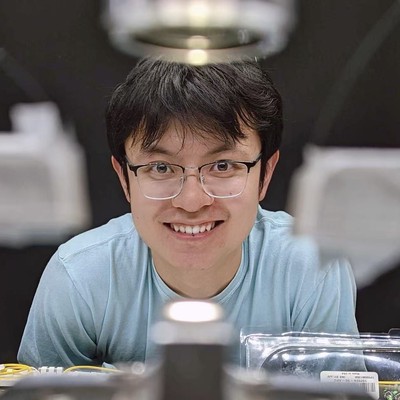
Lida was just starting his physics PhD.
Lida is in his final PhD year. Five years older.
Same hairline. Don't ask me how.
Three papers that mark where I've spent the most time. The full list — preprints, in-prep work, and media coverage — lives on the publications page.
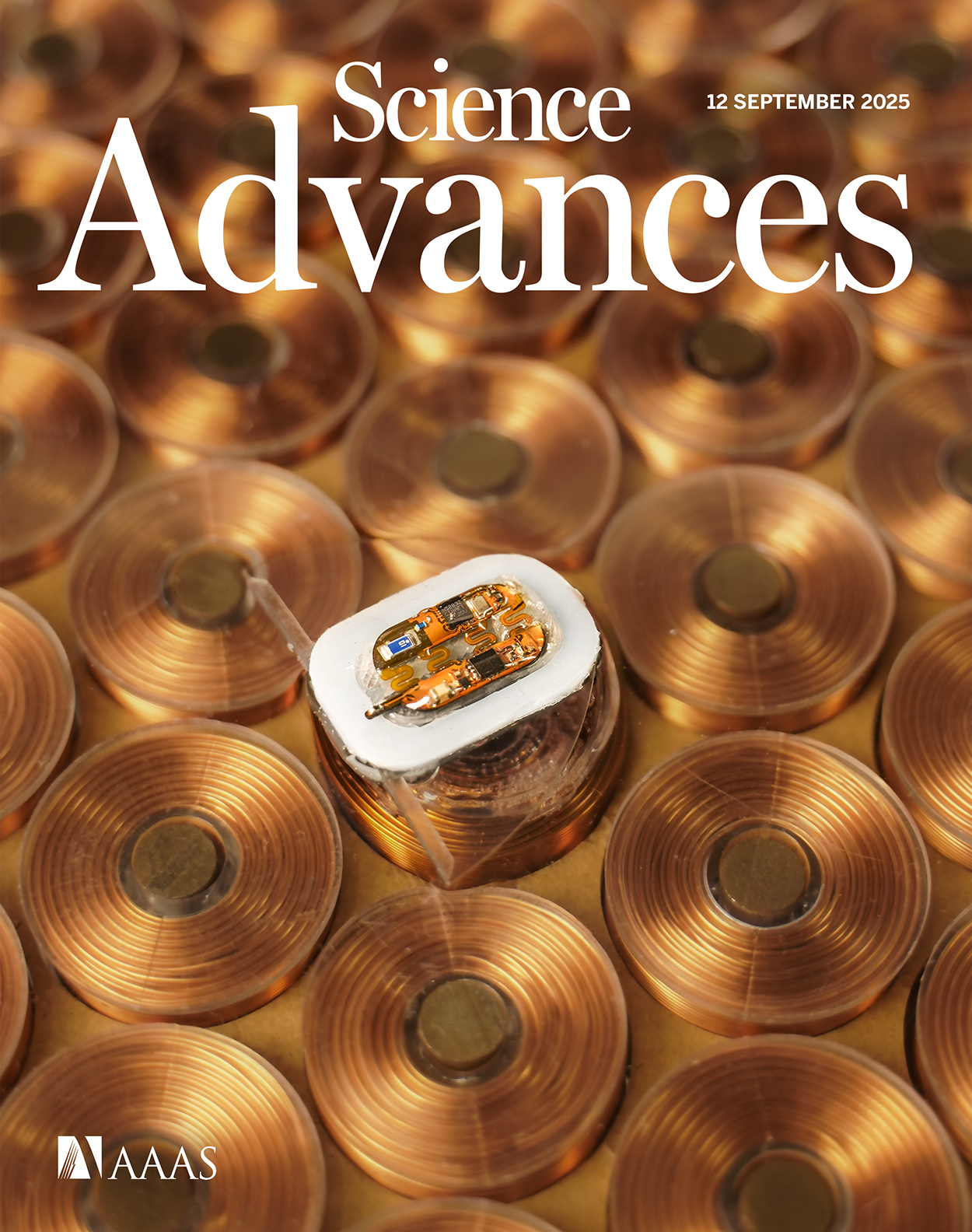
Helping nonlinear photonic chips work the same way twice — a step toward wafer-scale reliability.
Read the paper →
Two frequency combs locking together across wildly different timescales (1 THz and 4 GHz) on the same topological chip.
Read the paper →
The first experimental demo of frequency combs that inherit topological protection and nested structure from their lattice. Where a lot of my current work begins.
Read the paper →I think of myself as a hybrid — part physicist, part engineer, and somewhere between an experimentalist and a theorist.
My work sits at the intersection of topological photonics, nonlinear optics, and frequency combs — using the geometry of photonic lattices to make optical "rulers" that are stable, broadband, and chip-scale.
Fundamental science is cool, and I really want it to do something with it — that's the part that gets me out of bed.
— Lida
University of Maryland, College Park · Joint Quantum Institute
Advised by Prof. Mohammad Hafezi. Working on integrated nonlinear topological photonics — building photonic chips that turn ideas from condensed matter physics into useful devices.
Southern University of Science and Technology (SUSTech), Shenzhen
Gap year due to COVID between undergrad and PhD spent doing research and figuring out where to go next.
Nanjing University
Where it all started — my first taste of doing physics seriously.
Jiangsu Tianyi High School, Wuxi
Six formative years in a classroom, working out which questions felt worth asking.
Three intersecting threads I keep pulling on. Each is its own field — together, they're how I think about turning fundamental physics into devices.
Designing photonic lattices whose band structure inherits topological invariants from condensed matter — so light flows along boundaries that disorder can't disrupt.
Pushing high optical intensities into chip-scale waveguides until they generate frequency combs, harmonics, and entirely new colors of light — reliably, at wafer scale.
Asking whether the same lattices can do useful computation — using light's natural parallelism and topology's robustness to build a different kind of processor for AI workloads.
Four provisional US patents (filed 2025), all with equal share among co-inventors. These come out of joint work with the Hafezi Lab and collaborators at NIST.
A few highlights along the way — and one reminder that I am, in fact, capable of running.
I've been lucky to work with brilliant collaborators across UMD, NIST, and beyond. Science is a team sport, and the team makes it worth doing.
Theory and experiment, physics and engineering, fundamental and applied — I like the messy in-between. Sharp boundaries are usually wrong.
I write a lot of simulation software for our group. There's something satisfying about a tool that other people actually use.
I like explaining hard ideas in simple language. If a Nobel-Prize idea can't be told to a curious friend, we haven't finished understanding it yet.
A five-part deep dive into Paul Dirac and the strange world of antimatter, in Mandarin. Outreach is its own craft — and I love practicing it.
Watch the series →I'm always up for a good conversation — about photonics, collaborations, or anything else.